1984 PATRICK DIVISION SEMIFINALS, GAME 5: NEW YORK RANGERS AT NEW YORK ISLANDERS (April 10, 1984)
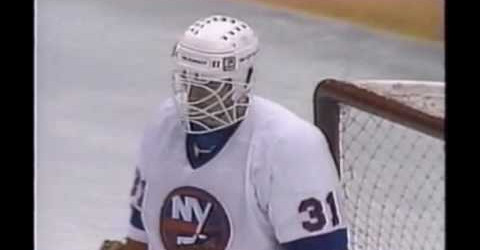
In 1980, the U.S. Olympic hockey team won gold at Lake Placid after upsetting the Soviet Union, 4-3, and subsequently defeating Finland in the final game. Aside from goaltender Jim Craig and forward Mike Eurizione–who scored the winning goal against the Soviets–defenseman Ken Morrow and head coach Herb Brooks are perhaps the most famous names associated with the victory. Morrow would join his NHL club, the New York Islanders, right after the Olympics. That spring, the Isles, led by Hall of Famers Bryan Trottier, Mike Bossy, Billy Smith and Denis Potvin, defeated the Flyers–thanks in part to linesman Leon Stickle–for the Stanley Cup, the first of four in a row. In the process, Morrow became the first player to win Olympic gold and Lord Stanley’s Cup in the same season.
One year later, Brooks took over head coaching duties for the New York Rangers for the start of the 1981-82 season, having been hired by young general manager Craig Patrick. Patrick had been Brooks’ assistant in Lake Placid–ironically enough–and had been doubling as coach of the Broadway Blueshirts after the departure of former Flyers coach Fred Shero. (Freddy the Fog voluntarily stepped down following a dismal start to the campaign.)
The two New York hockey teams faced each other in the postseason four consecutive springs. Patrick guided the Rangers to the semifinals in ’81, only to be swept by the Isles in four straight. Under Brooks, the Rangers met their rivals in the Patrick Division Finals–the second round of the playoffs–in ’82 and ’83, both times bowing to the Islander dynasty in six games.
In ’84, Fate must have figured, “Why wait? Let’s get it over with in Round 1.” The Rangers won four of seven matches with the Isles during the regular season, but managed only a fourth place finish in the division with 93 points. The Islanders won their third Patrick Division regular season title in four seasons with 104 points, after finishing second the previous campaign.
Back then, the first round–the division semifinals–was only best of five, and not seven, games, with a 2-2-1 format. In other words, the first two games were played in the higher seeded team’s arena; Games 3 and (if necessary) 4 were played in the other team’s building; and the series returned to the higher seeded team’s ice for the fifth and final contest (again, if necessary).
The Islanders remained the overwhelming favorites to win the series. The team had won their last 16 playoff series–a feat previously unheard of–and most of their core were still in the primes of their careers. Trottier and Bossy both enjoyed 100-point regular seasons, with Bossy leading the team with 51 goals despite missing 13 games. Potvin remained one of the best two-way blueliners in the league. John Tonelli averaged nearly a point per game. Young forwards Brent Sutter and Greg Gilbert both reached the 30-goal plateau. (The Islanders boasted two of the league’s six Sutter brothers, Duane being the other.) Swedish import Tomas Jonsson posted another great season as the team’s “second” offensive defenseman. The goaltending platoon of Smith, Roland Melanson, and rookie Kelly Hrudey combined to lead the league in team save percentage. And perhaps the biggest reason for optimism was the addition of young phenom Pat LaFontaine, who “pulled a Morrow,” joining the team after playing for Team USA in that year’s Olympic Games. LaFontaine scored 13 goals in 15 games down the stretch.
With a roster like that, there was no reason to believe the Islanders’ “Drive for Five” would fail.
True to form, the four-time defending champions took Game 1, 4-1, on the strength of a brilliant display of goaltending from Smith. The Rangers evened things up with a 3-0 shutout in Game 2, thanks to 45 saves from Glen Hanlon. The Blueshirts then demolished the Isles, 7-2, in Game 3 at Madison Square Garden, thanks to two goals by Pierre Larouche and a four-point night from another member of the Miracle on Ice team, Mark Pavelich; Smith was chased from the net after giving up five goals on just 18 shots. “Battlin’ Billy” rebounded for Game 4, guiding his team to another 4-1 win which sent the series back to Nassau Coliseum for the deciding Game 5. The stage was set.
Neither team wasted time setting a tone. Play went back and forth with little impedance–it WAS the ’80s. Rangers defenseman Ron Greschner, arguably known better for marrying Sports Illustrated swimsuit cover model Carol Alt, opened the scoring just past the 12-minute mark of the opening period. Morrow had cleared the puck from the Islanders’ zone, only for it to find Greschner’s stick. Playing in place of the injured Barry Beck, Mr. Carol Alt deftly carried the puck all the way to the opposite corner, with Potvin in pursuit. The Hall of Famer couldn’t keep pace with the supermodel’s husband, as Greschner swung away and sneaked right in on Smith, cleanly beating him with a wrist shot. 1-0, Rangers.
The Rangers seemed to control play for most the rest of the period. But the Isles caught a break in the final minute when Rangers defender Tom Laidlaw misplayed an oncoming puck at his team’s blue line. Bossy moved right in, stripping the puck from the young defenseman’s stick, and scored on Hanlon to tie the game with just 11 seconds left on the clock.
The second period featured the most penalties in the game, none of which bore any consequences of note. Interestingly, Hanlon earned both of the Rangers’ infractions. The third period commenced with both teams relentlessly pursuing the puck at any and all points of the ice. The tie was finally broken when Duane Sutter threaded one beautiful pass back to the point, where Jonsson hammered it past Hanlon. 2-1, Isles.
Less than a minute later, Bossy was called for elbowing, leading to a tense penalty kill. Smith made several of his 42 saves during this stretch to preserve the lead. Tonelli nearly gave the Islanders a two-goal cushion when he broke in on Hanlon all alone just past the midpoint of the period, but the Rangers backstop held firm.
With roughly 90 seconds left to play, the Rangers pulled Hanlon for the extra attacker. After a stoppage shortly afterward, Islander coach Al Arbour called a timeout to rest his troops. Brooks countered by taking advantage of the rule governing warm-up time for goalies: He briefly inserted the Rangers other netminder, a rookie named John Vanbiesbrouck, into the game. This mandated another stoppage of play to allow Beezer to properly warm-up, thereby giving the other Ranger players an extended break. When play resumed, Brooks pulled the young backup goalie as he had Hanlon, and the Blueshirts once again had an extra attacker. The plan apparently worked. With just 39 seconds left in regulation, Don Maloney knocked in a crazy deflection off Smith’s pads to tie the game. Yet another young Rangers defenseman, James Patrick, had carried the puck into the Islanders’ zone, passing it to Pavelich, who shot at Smith, who made the initial stop. In so doing, however, he inadvertently deflected the rubber disk into the air, where an oncoming Maloney was able to swat it into the net. After several replays showing that Maloney did not resort to a hand-pass and had his stick lower than the crossbar–as was the rule–the goal stood. 2-2. The Drive for Five was once again in jeopardy.
Overtime continued the same, constant back-and-forth intensity as had been displayed earlier. Both teams had numerous chances to end the game (and the series). Hanlon stoned Bossy on a three-on-one, then Smith did the same to Maloney at the other end. Finally, approaching the 9-minute mark, Brent Sutter fired a left-circle shot that was kicked away by Hanlon. Unfortunately for the Rangers’ goaltender, the puck went to the opposite circle, right to an approaching Morrow. The Olympian, not known for offense, fired a shot that bolted right past Hanlon and into the Ranger net. 3-2, Islanders, for the game and for the series.
********************
AFTERMATH
The Drive for Five ultimately fell short, as a new dynasty began in Edmonton. The Oilers, having been swept by the Islanders in the Finals the previous spring, won in five games this time. It was their first of five titles in a seven-year span. With the loss, the Islanders nonetheless managed to win an unprecedented 19 consecutive playoff series. No other team has come close to matching that accomplishment.
The Rangers would struggle the next season, ultimately costing Herb Brooks his job at mid-season. Craig Patrick once again stepped behind the bench for the interim, guiding the team to another fourth-place finish in the Patrick Division. That set up a date with the Flyers in the first round. The Orange and Black had prospered under first-year coach Mike Keenan, winning the Patrick Division and the Presidents’ Trophy as the NHL’s best regular season team that season. The Flyers swept the Rangers in three straight, then defeated the Islanders in five games in Round 2 en route to the Stanley Cup Finals, where they, like the Isles the previous postseason, lost to Edmonton four games to one.
John Vanbiesbrouck would become the Rangers’ starting goaltender the following year, winning the Vezina in the process, and leading the Blueshirts to a revenge upset win over the Flyers in the first round of the ’86 playoffs. The Rangers became the NHL’s Cinderella story that spring, losing to the eventual Cup winning Montreal Canadiens in the Wales Conference Finals.
The Islander dynasty was over but the team remained a darkhorse playoff contender for the next few seasons, and enjoyed some memorable moments along the way, notably the famed “Easter Epic” against Washington in ’87. Beginning in ’85, Billy Smith rode the pine in favor of the emerging Kelly Hrudey; Hrudey would make the Canadian team for the 1987 Canada Cup, albeit as a backup. Mike Bossy retired at age 30 following the 1986-87 season, due to chronic back problems. Potvin retired after the Isles were eliminated by the New Jersey Devils in the following year’s playoffs. Trottier gradually declined as LaFontaine flourished. He would ultimately land in Pittsburgh as a checking center, playing behind Mario Lemieux and Ron Francis, and earning two more Stanley Cups in the process.
The overtime hero of Game 5 versus the Rangers, Ken Morrow, suffered from knee problems during much of his career. Like Bossy, he was forced into premature retirement, in 1989.
Herb Brooks, Morrow’s coach in Lake Placid and adversary in the NHL, ultimately wound up back with the U.S. national team, only this time with NHL players. He would guide the team to a silver medal in Salt Lake City in the 2002 Games.
WATCH THE GAME HERE (although I should note the first few minutes of the first period are missing; I didn’t have that problem, as I have the game on DVD!): https://www.youtube.com/watch?v=rdXAHGqIVIw