1979 STANLEY CUP SEMIFINALS, GAME 7: BOSTON BRUINS AT MONTREAL CANADIENS (MAY 10, 1979)
**********************************************************************
——————–
BACKSTORY
——————–
If you have ever lived in Canada, or at least been able to watch a hockey game on CBC’s “Hockey Night in Canada” Saturday night telecasts, you’re familiar with one of hockey’s most colorful and outspoken commentators, a former NHL head coach with a taste for conspicuous three-piece suits: Don Cherry. Cherry co-hosts a segment entitled “Coach’s Corner” with anchor Ron MacLean, which airs during the first intermission of the first game of every Saturday night double-header. Cherry is the mouthpiece; MacLean is essentially his foil. (Think Abbott and Costello, meshed with Hannity and Colmes.) It’s a highly entertaining segment dating back over thirty years.
Before joining Hockey Night in Canada, or “HNiC,” full-time in 1981, Cherry was an accomplished NHL bench boss for six seasons, the first five of which were spent with the Bruins. The team hired him during the 1974 off-season to replace Bep Guidolin, who left to take the coaching job for one of the league’s two expansion teams for that campaign, the Kansas City Scouts. In Guidolin’s only full season as the Bruins’ skipper, the team lost in the Finals to the Flyers in six games. Cherry guided the team to a second place finish in the Adams Division his first year at the helm; Boston was subsequently defeated in the best-of-three preliminary round by the Chicago Blackhawks.
The 1974-75 season would prove to be the final full campaign for both of Boston’s superstars, Bobby Orr and Phil Esposito. Orr’s chronic knee injuries limited him to just ten contests the next year. “Espo” met a very different fate. Clashing with Cherry’s coaching style almost from the get-go, Bruins management made a bold decision. On November 7, 1975, just a dozen games into Cherry’s second season as head coach, the team traded Espo and defenseman Carol Vadnais to the New York Rangers for fellow star center Jean Ratelle, perennial all-star defenseman Brad Park, and defenseman Joe Zanussi. (Zanussi was out of the NHL within two years.) It remains one of the most monumental trades in league history. After languishing around the .500 mark early in the season, the Bruins caught fire, winning the division with 113 points and netting Cherry a Jack Adams Award in the process. Alas, the B’s fell short of the Stanley Cup, falling to the now two-time defending champion Flyers in a five-game semifinal loss.
That spring marked the end of the Broad Street Bullies’ reign at the top, and the start of a new dynasty in Montreal, as the Habs won the Finals in four straight games behind the goaltending of Ken Dryden and a lineup loaded with Hall of Famers. The next month, the Bruins said farewell to their other superstar, allowing Orr to sign with Chicago as a free agent.
After serving as an assistant coach for Team Canada for the inaugural Canada Cup that fall, Cherry led the Bruins to another Adams Division title, and revenge against the Flyers in the form of a four-game semifinal sweep. However, the Black and Gold were in turn swept by the defending champion Canadiens in the Cup Finals. One year later, it was an almost identical story: Another division crown, another semifinal victory over the Flyers (this time in five games), and another loss to the Habs in the championship round (this time in six).
The spring of 1979 marked the third consecutive year the Canadiens and Bruins met late in the postseason, only this time, it was in the semifinal round. How was this possible, if they were in the same conference? Because these were the days when, though the four divisions determined which teams qualified for the playoffs–the top three in each group during the late 1970s–they were disregarded afterward; the twelve lucky teams were simply seeded #1 through #12, with the top four earning a “bye” and going straight to the quarterfinals. In 1979, Montreal was #2, as the New York Islanders were the best regular season team that season, and Boston was #3. After the preliminary round, the top-seeded Islanders faced the lowest remaining seed (Chicago), #2 Montreal faced the second-lowest remaining seed (the Toronto Maple Leafs), and so on. The top four seeds–the Islanders, Canadiens, Bruins, and Rangers–all won their respective quarterfinal series. For the semifinals, then, the #1 Islanders faced the #4 Rangers (the lowest remaining seed), while the #2 Habs squared off against the #3 Bruins.
In a series where the home team won every game, the Habs jumped to a 2-0 lead, chasing Hall of Fame goalie Gerry Cheevers from the Bruins’ net. Gilles Gilbert (pronounced ZHILL zhil-BAIR) would man the Boston crease the rest of the way. The Bruins took the next two games at the Boston Garden to even the series at two games apiece. The Habs dominated Game 5 back at the Forum; the Bruins did the same in Game 6. Series tied 3-3, with Game 7 taking place on Forum ice.
The stage was set.
——————–
THE GAME
——————–
Game 7 got off to a blistering start, with almost ceaseless end-to-end rushes. Just past the halfway mark of the opening period, Canadiens defenseman Rick Chartraw took a penalty, and on the ensuing Boston power play, young Bruins sniper Rick Middleton put one past Dryden to give his team the early 1-0 lead. Not three minutes later, however, Jacques Lemaire evened things up for the Habs with a power play tally of his own. Gilbert made several saves within seconds of each other, but the Bruin defense was just not able to clear the zone, allowing Lemaire to finally jam home the equalizer.
Montreal basically dictated play for most of the rest of the period, which turned into the Gilles Gilbert show. This was the era of the “stand-up” goaltender; Gilbert made stop after stop in various fashions, notably a kicksave on Guy Lafleur late in the period. Bruins forward Don Marcotte took down Lafleur at the end of the play, in order to protect his goalie, and he was whistled off. Gilbert continued to deny the Habs during the ensuing penalty kill, and the teams remained tied entering the first intermission.
That changed just 27 seconds into the second stanza. Longtime Bruin–and future Flyers head coach–Wayne Cashman took a behind-the-net pass from Middleton, with Ratelle tying up a Montreal defender along the boards. Cashman stuffed the puck into the net just inside the post. 2-1, Bruins.
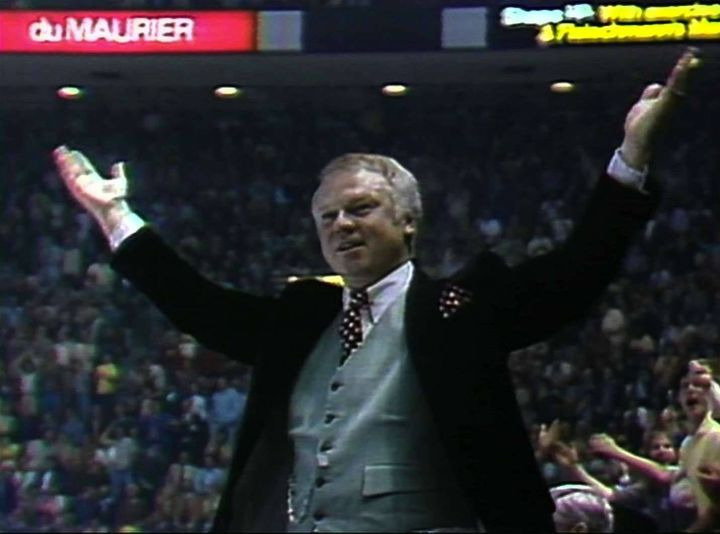
During the bulk of the period, Gilbert continued to dazzle, frustrating many a Montreal shooter. He robbed Bob Gainey on a left-circle slapper, then later, on another Canadien power play–Ratelle was called for an uncharacteristic hooking penalty–stoned Serge Savard from in close. Coincidental minors were called–Guy Lapointe for the Habs, Marcotte for the B’s–prompting Cherry to stand on his team’s bench, pleading in an animated fashion, as he was known to do (see picture). His concern was warranted; in those days, coincidental minors didn’t “cancel out,” so the teams were at 4-on-3 in favor of Montreal for the time being.
Fortunately for Boston, the Habs’ All-Star winger Steve Shutt was called for crosschecking soon afterward, ending the power play. When Ratelle’s penalty expired, it was the Bruins’ turn. Ratelle himself skated in on Dryden, but was stopped cold, as was center Peter McNab. At the other end, Gilbert robbed Yvon Lambert in the slot. Finally, with just under four minutes remaining in the period, Cashman struck again, cruising around the Montreal net and cleanly beating Dryden with a wrister, with assists from Ratelle and Middleton. 3-1, Bruins.
Happy Gilmore’s favorite hockey player, Terry O’Reilly, missed a golden opportunity to make it 4-1 when he shot wide with a half-empty net. The score remained 3-1 after two periods of play.
The final period opened with Montreal once again dictating play in the Boston zone, only to fail to get the puck past Gilles Gilbert. Finally, just past the six-minute mark, Lafleur skated freely into the offensive zone along the right-side boards, whirling effortlessly around the Bruin net. He then laced a perfect pass to his linemate Mark Napier, who buried a shot past Gilbert. The Forum, eerily silent for some time prior, erupted as the Bleu, Blanc, et Rouge were now back within one.
Roughly only a minute later, Bruins defenseman Dick Redmond was called for hauling down Lemaire on another scoring chance. On the ensuing power play, and barely over two minutes after the Napier goal, Lafleur once again displayed his skating and puck-handling artistry, zipping around the Bruin net and threading yet another tape-to-tape pass, this time to Lapointe at the top of the slot. The Habs’ “other” great offensive blueliner (after Larry Robinson) fired a slap shot past a badly screened Gilbert to tie the game at 3.
The Bruins regrouped, but the Canadiens seemed to own most of the scoring chances for the rest of regulation. Gilbert continued to keep his team in the game. The hero for the Habs at that point, Lapointe, collided with Middleton and Milbury in a scrum along the Boston end boards; he was carried off on a stretcher. Then, as the clock showed just four minutes remaining, Middleton potted his second goal of the game to restore Boston’s lead. The Bruins’ young star forward, obtained from the Rangers as Park and Ratelle were (but in a separate transaction), came from behind the Montreal net and backhanded the puck toward the far-side post. It trickled underneath Dryden’s pads and into the net. 4-3. The Bruins merely had to play smart, positionally sound hockey for not even four minutes, and they would be on their way to the Stanley Cup Finals.
However, with 2:34 left in regulation, they botched a line change by leaving an extra skater on the ice too long. (Cherry later admitted it was his own fault.) Montreal coach Scotty Bowman sent out the legendary power play unit of Lafleur, Lemaire, Shutt, Robinson, and Savard, and let them go to work. With under a minute and a half left on the clock, Lemaire entered the Boston zone. At the right circle, he dispensed a drop pass for Lafleur, who rocketed a slapper. Gilbert had virtually no chance. 4-4. The Canadiens’ playoff hopes had been saved . . . at least for the time being.
The final minute and change elapsed, and the teams entered sudden death overtime. The next goal would win not only the game, but the series.
Early in the O.T. period, the Boston attack reasserted itself, putting numerous pucks toward the Montreal net. Dryden stoned Marcotte on an angle shot. A short time later, Lafleur almost won it for the Habs, but his shot was just wide. Gilbert just barely prevented the puck from slipping past the goal line shortly afterward on a Lemaire deflection. Mario Tremblay missed with lots of open net in front of him.
Finally, nine and a half minutes in, Tremblay entered the Boston zone along the right side boards and advanced past the circle, where he whipped a pass to Yvon Lambert, one of Montreal’s “other” stars. Lambert took the pass right on the “doorstep” of the Boston net, and tipped it home. 5-4, Canadiens. Final.
Despite surrendering the goal, Gilles Gilbert was named the game’s first star for having stopped 47 of 52 shots and having outplayed Ken Dryden.
——————–
AFTERMATH
——————–
After dropping the first game of the Stanley Cup Finals by a 4-1 score, the Canadiens won the next four to defeat the Phil Esposito-led (and Fred Shero-coached) New York Rangers for their fourth consecutive Stanley Cup. Ken Dryden retired that off-season after just eight seasons in the league. He hoisted the Cup in six of them. He went on to become a lawyer, and later helmed the front office in Toronto.
Also hanging them up after the ’79 Cup victory was Jacques Lemaire. He would enter the coaching ranks, first with his former team in 1983, for two years. He remains most famous for his Stanley Cup triumph with the New Jersey Devils in 1995, due in large part to his employment of the neutral zone trap. He would later coach the expansion Minnesota Wild to a Conference Finals appearance in only their third year of existence.
Scotty Bowman also parted ways with Montreal after Cup #4, after clashing with team management over being passed over for general manager after Sam Pollock’s retirement the previous year. Bowman found himself in Buffalo the next season, where he would remain through the 1985-86 campaign. That final year in Buffalo would prove the only one in his entire NHL head coaching career that Bowman would fail to take his team to the playoffs. He found himself in Pittsurgh in 1990, first as director of player personnel, then taking over as head coach after Bob Johnson’s cancer diagnosis. Johnson would pass away in the fall of 1991, and Bowman would guide the team to their second straight Cup the following spring. In 1993, Scotty moved on to Detroit, where he would win three more Stanley Cups, for a total of nine as an NHL head coach, a league record.
His adversary in this game, Don Cherry, was fired by Bruins general manager Harry Sinden not too long after the too-many-men debacle. It didn’t take him long to find work, however, as the Colorado Rockies brought him aboard for the 1979-80 campaign. After placing last in the entire NHL, he was fired yet again. Cherry joined Hockey Night in Canada within a year of his dismissal from Colorado. He never coached in the NHL again.
That same year, the Canadiens saw their quest for a fifth consecutive Stanley Cup come to an abrupt end, courtesy of Al MacAdam and the Minnesota North Stars, in the second round of the 1980 playoffs. That spring would witness the dawn of a new dynasty on Long Island, as the Islanders defeated the Flyers for their first of four consecutive Cups.
Gilles Gilbert played one more season in Boston, manning the crease in a December 1979 loss to the Flyers that gave the Orange and Black the league record for most consecutive games without a loss. He followed up that campaign with three unremarkable seasons as a backup in Detroit before calling it quits.
Wayne Cashman played four more seasons, finishing out his career in Boston in 1983. At the time, he was the last remaining player from the “Original Six” era still in the league.
Rick Middleton enjoyed a great career in Boston. He would set an NHL record for most points in a playoff series with 19 during the 1983 quarterfinals against the Buffalo Sabres. In 1986, he was struck in the head–specifically the temple area–by a puck during a practice session, causing him to miss almost half of that regular season and the entire playoffs. He returned to score 31 goals the following year, but retired following the subsequent campaign due to lingering effects of the injury. He ended his career a dozen points shy of 1,000.
Yvon Lambert gave the Habs two more fine seasons before finishing his NHL career in Buffalo in 1982. By that time, most of the late ’70s Montreal dynasty had either retired or moved on to other teams, including two of the “Big Three” defensemen: Guy Lapointe and Serge Savard, as well as younger defensemen Rod Langway and Brian Engblom. Langway would win two Norris Trophies as the captain of the Washington Capitals. Engblom would enjoy a career as an analyst after the end of his playing days, as would Mike Milbury of the Bruins . . . and of course, Cherry.
Montreal’s next Cup came in 1986 behind the play of rookie netminder Patrick Roy. However, two key players remained from the Bowman era: Larry Robinson and Bob Gainey.
In all, ten players from this game were later inducted into the Hockey Hall of Fame: Robinson, Lapointe, Savard, Langway, Lafleur, Lemaire, Dryden, Shutt, Park, and Ratelle.
WATCH A CONDENSED VERSION OF THE GAME HERE: https://www.youtube.com/watch?v=15p0nZYNJFE